Box Shadow: man coverage drill for flag football
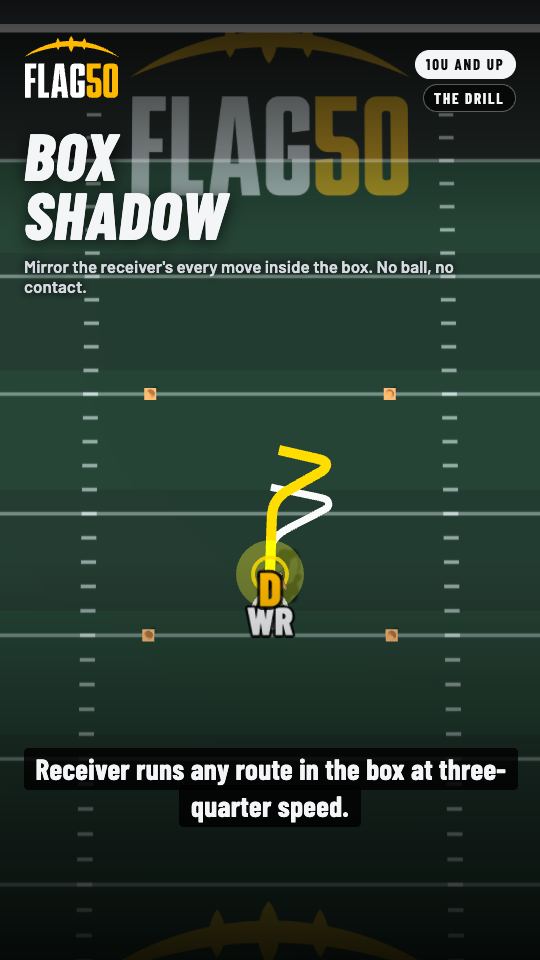
Box Shadow is a flag football drill that teaches man coverage to players ages 10 and up. A receiver runs any route inside a 10 by 10 yard box of 4 cones for 5 seconds while a defender mirrors every move within arm's reach. It takes 2 players at a time and no ball.
Keep score and stats for your team with Flag50 Coach, then send parents one link to follow live. Launching spring 2027. Get early access.
By Jay Fraser. Published . Updated .
Box Shadow at a glance
- Ages
- Ages 10 and up
- Players
- 2 at a time: a receiver and a defender
- Time
- 6 minutes
- Equipment
- 4 cones, no ball needed
- Skill
- Man Coverage
- Difficulty
- Intermediate
How to run Box Shadow
A no-ball man coverage drill for 10U and older players: a receiver runs any route inside a 10 by 10 yard box at three-quarter speed for 5 seconds, and the defender mirrors every move within arm's reach.
Motion data: CMU Graphics Lab Motion Capture Database (mocap.cs.cmu.edu)
- Set four cones in a box about 10 by 10 yards. The receiver starts near one side of the box. The defender starts an arm's reach away, facing the receiver.
- On "go," the receiver runs any route inside the box at three-quarter speed: cuts, stops and turns.
- The defender mirrors every move with eyes on the receiver's hips, staying within an arm's reach without touching.
- After 5 seconds the coach calls "stop." Both freeze and check the distance. Switch roles.
Safety: No contact: the defender stays close with the feet and never holds or bumps. Run one pair per box, with boxes at least 5 yards apart.
Coaching cue
Watch the hips. The hips tell you where the receiver is going.
- Watch the hips. The hips tell you where the receiver is going.
- Turn your hips with the cut, then run. Do not wait for the whole body to move.
- Your feet keep you close. No touching, no holding and no bumping.
Common mistakes
- Watching the head and shoulders, which is where the fakes are.
- Reaching out with the hands to stay close instead of moving the feet.
- Letting a gap open on the first cut, then never closing it.
Make it easier or harder
Make it easier: The receiver jogs at half speed and makes only one cut per rep.
Make it harder: Shrink the box to 7 by 7 yards, or stretch each rep to 8 seconds.
For your players
Read these three lines to your players before the first rep.
- Start close to the receiver.
- Watch their hips, not their head.
- Go everywhere they go. Stay close enough to touch, but never touch.
Where it shows up in a game
Man coverage after the snap: staying with one receiver through every cut before the ball is thrown.
- Cover 1: 5v5 (NFL FLAG rules)
- Cover 1 Man: 6v6 (FNL rules)
- Cover 1: 7v7 (NFHS high school)
Flag50 Coach
Keep score and stats for your team with Flag50 Coach, then send parents one link to follow live.
Get early access. Leave your email and we'll email you the moment your spot opens up.
Frequently asked questions
Why is there no ball in Box Shadow?
With no ball, the defender's eyes stay on the receiver's hips for the whole rep. Coverage footwork comes first. Add a thrower and a catch once players can stay within an arm's reach for all 5 seconds.
How long should each rep of Box Shadow last?
5 seconds at three-quarter speed. That is long enough for 2 or 3 cuts and short enough that tired legs do not take over. Rest while your partner takes a turn.
How is Box Shadow different from Shadow the Receiver?
Shadow the Receiver is a first coverage drill for 6U to 10U players, with a thrower, one set route and a flag pull after the catch. Box Shadow is for 10U and older: no ball, any route the receiver chooses, and the only goal is staying within reach.