February 3, 2026 Flag50 Team
The Road to LA28: How Olympic Flag Football Qualification Actually Works
Flag football debuts at the 2028 Olympics with six teams per gender. Here is the confirmed qualification path, from the 2026 Worlds to the 2028 Q-Series.

Flag football's Olympic debut is set for Los Angeles in 2028, and as of early February the qualification system is officially confirmed. It is tighter than most people expect: just six teams per gender, and only one guaranteed spot for the host. Here is how a nation gets to the Games.
Six teams, one host bid
The confirmed qualification system puts six teams per gender in the Olympic tournament. The United States, as host, qualifies automatically in both the men's and women's competitions. That leaves five spots per gender for the rest of the world to fight over, which is what makes the path so competitive.
With only five available bids per gender across every other flag football nation on earth, qualification is a genuine bottleneck. The system spreads that competition across three stages over roughly two years.
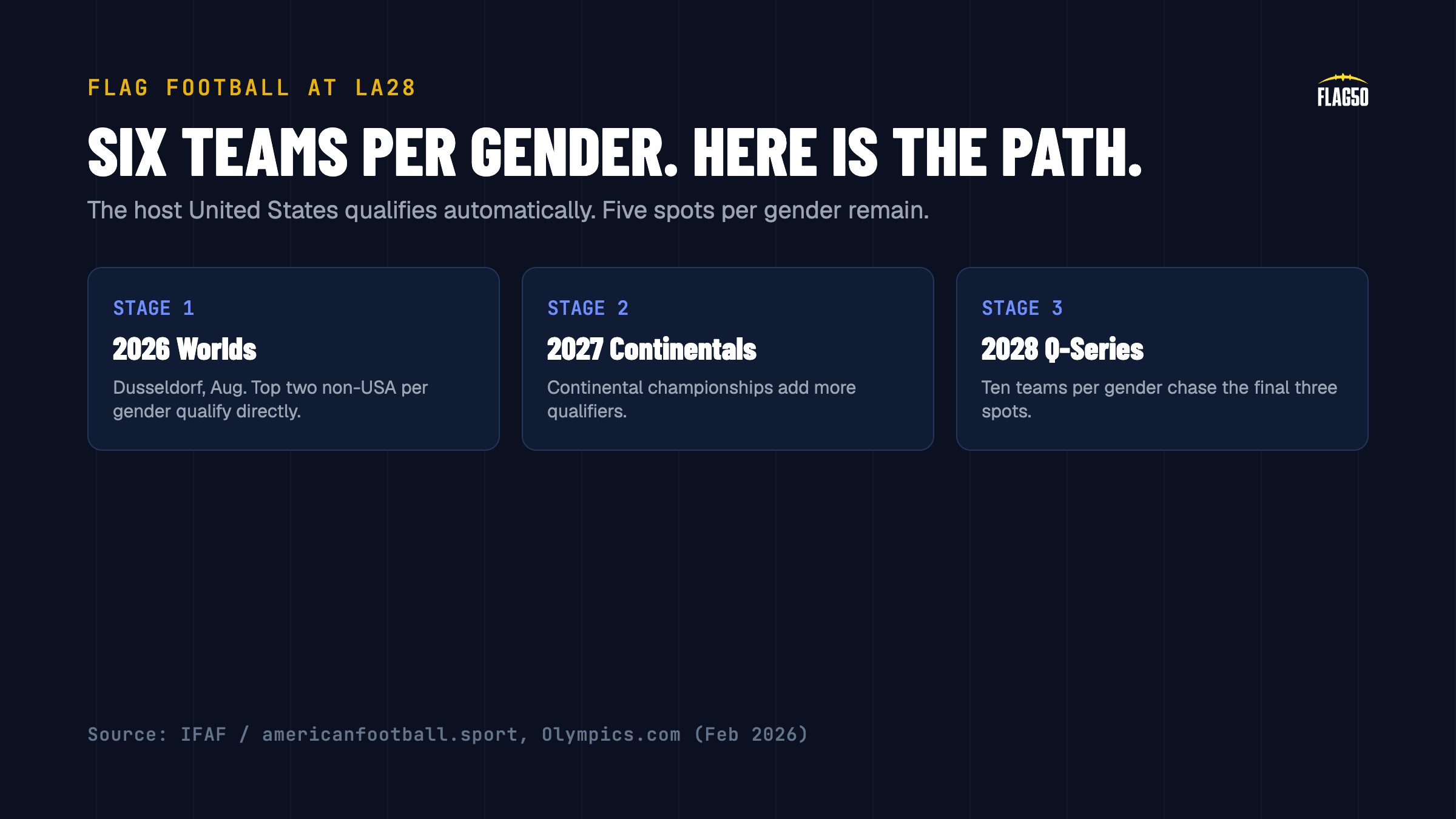 The host United States qualifies automatically. Five spots per gender remain, decided across three stages from 2026 to 2028.
Stage one: the 2026 World Championship
The first and most direct opportunity is the 2026 IFAF Flag Football World Championship, scheduled for Dusseldorf, Germany. At the Worlds, the top two non-USA finishers in each gender qualify directly for the Olympics. That is the cleanest route to Los Angeles: finish near the top in Germany and your ticket is punched.
Because the United States is already in as host, its result in Dusseldorf does not affect these two qualifying spots, which go to the best of everyone else. For the sport's rising powers, the 2026 Worlds are effectively the first Olympic qualifier.
Stage two: the 2027 Continental Championships
Nations that miss out in Dusseldorf get a second chance the following year. The 2027 Continental Championships add more qualifiers to the field, giving each region a pathway and ensuring the Olympic tournament is not decided by a single event. It is the middle rung of the ladder, between the direct route at Worlds and the last-chance stage that follows.
Stage three: the 2028 Olympic Q-Series
The final opportunity is the 2028 Olympic Qualifier Series, held in the spring or summer of the Olympic year. Ten teams per gender compete for the final three spots. It is the last chance to reach the Games, a high-stakes scramble among the nations that came up short at the two earlier stages.
Why the structure matters
The three-stage design does two things at once. It rewards early excellence, since the fastest route is simply to win at the 2026 Worlds, and it keeps hope alive for developing programs through 2027 and into 2028. That balance is deliberate: World Athletics-style qualification systems are built to grow a sport, not just crown the teams that are already best.
For a sport making its Olympic debut, the path also creates a clear competitive calendar. Every national team now knows exactly what it is playing for and when, starting with Dusseldorf. And the ripple effects reach all the way down to the college and high school programs filling the talent pipeline, because an Olympic dream needs somewhere to start.
Flag50 runs live scoring, standings, and brackets for flag football events at every level. Start free and run your tournament without the spreadsheets.